
Day 1: Starting Plausible CE
Goal: Plausible Community Edition runs as a Compose stack, you have created the first user and the site
itdrills.com, closed registration and know whydocker compose restartignores a changed.env. · Duration: approx. 60 min · Prerequisite: Day 0
Briefing
- For the Community Edition, Plausible provides a repo of its own,
plausible/community-edition, withcompose.yml, ClickHouse configuration and a wiki. Every version is a branch of its own (no Git tags) – you clone the branchv3.2.1. - Three services:
plausible(the application, Elixir),plausible_db(PostgreSQL 16: users, sites, goals) andplausible_events_db(ClickHouse 24.12: every pageview, every event). - Your own values belong in
.envandcompose.override.yml– the bundledcompose.ymlstays unchanged, so that an upgrade is just a branch switch (Day 9). - Two keys in
.envare critical:SECRET_KEY_BASE(sessions, signatures) andTOTP_VAULT_KEY(encrypts the two-factor secrets). Lose them and you lose the logins – Day 8. - The Community Edition has no funnels, no revenue goals, no SSO and no Sites API. What it offers in exchange: direct access to the raw data in ClickHouse.
 Browser ──► :8000 plausible (v3.2.1)
                    ├─► plausible_db         PostgreSQL 16    users, sites, goals
                    └─► plausible_events_db  ClickHouse 24.12 events, sessions
 Volumes: ce_db-data  ce_event-data  ce_event-logs  ce_plausible-data
Drill 1: The CE repo
# on argo
cd ~/plausible
git clone -q -b v3.2.1 --single-branch \
  https://github.com/plausible/community-edition ce \
  2>&1 | grep -v detached
cd ce && git log --oneline -1
ls
grep 'image:' compose.yml
Expected:
ec6c4da Update v3.2.1
LICENSE
README.md
clickhouse
compose.yml
    image: postgres:16-alpine
    image: clickhouse/clickhouse-server:24.12-alpine
    image: ghcr.io/plausible/community-edition:v3.2.1
clickhouse/ contains configuration files that make
ClickHouse more frugal (fewer system logs, IPv4 only) – Day 9 takes a
look inside.
Save your progress? Sign up for free
Drill 2: Your own values
BASE_URL is the address under which browsers reach
Plausible – it ends up in the tracking snippet. openssl
generates the two keys.
# on argo
cd ~/plausible/ce
cat > .env <<EOF
BASE_URL=http://plausible.lab:8000
SECRET_KEY_BASE=$(openssl rand -base64 48)
TOTP_VAULT_KEY=$(openssl rand -base64 32)
HTTP_PORT=8000
EOF
chmod 600 .env
sed 's/=.*/=…/' .env
cat > compose.override.yml <<'EOF'
services:
  plausible:
    ports:
      - 8000:8000
EOF
docker compose config --services
Expected:
BASE_URL=…
SECRET_KEY_BASE=…
TOTP_VAULT_KEY=…
HTTP_PORT=…
plausible_db
plausible_events_db
plausible
HTTP_PORT is the port inside the
container; ports in the override file makes it reachable on
the VM. Compose reads compose.yml,
compose.override.yml and .env from the current
directory automatically.
Warning:
.envcontains secrets and does not belong in any Git repo. Back it up anyway – without the two keys a restore is worthless (Day 8).
Save your progress? Sign up for free
Drill 3: The start
# on argo
cd ~/plausible/ce
docker compose up -d --quiet-pull 2>&1 | tail -2
until curl -sf http://plausible.lab:8000/api/health >/dev/null; do sleep 5; done
docker compose ps --format '{{.Service}}\t{{.Status}}'
docker stats --no-stream --format '{{.Name}} {{.MemUsage}}' | sed 's/ \/.*//'
curl -s http://plausible.lab:8000/api/health; echo
Expected (times differ):
 Container ce-plausible-1 Starting
 Container ce-plausible-1 Started
plausible   Up 56 seconds
plausible_db    Up About a minute (healthy)
plausible_events_db Up About a minute (healthy)
ce-plausible-1 394.2MiB
ce-plausible_db-1 64.95MiB
ce-plausible_events_db-1 172.7MiB
site 4.773MiB
{"sessions":"ok","postgres":"ok","clickhouse":"ok","sites_cache":"ok"}
plausible waits until both databases are healthy and
runs the migrations on startup – that takes a good minute; the
until loop waits until /api/health answers.
Around 630 MiB for all three – when idle.
Save your progress? Sign up for free
Drill 4: The first user
The first user is created in the browser. On your machine (with the
hosts entry from Day 0), open
http://plausible.lab:8000/register and enter: name
Lab Admin, email [email protected], password
lab-plausible-123.
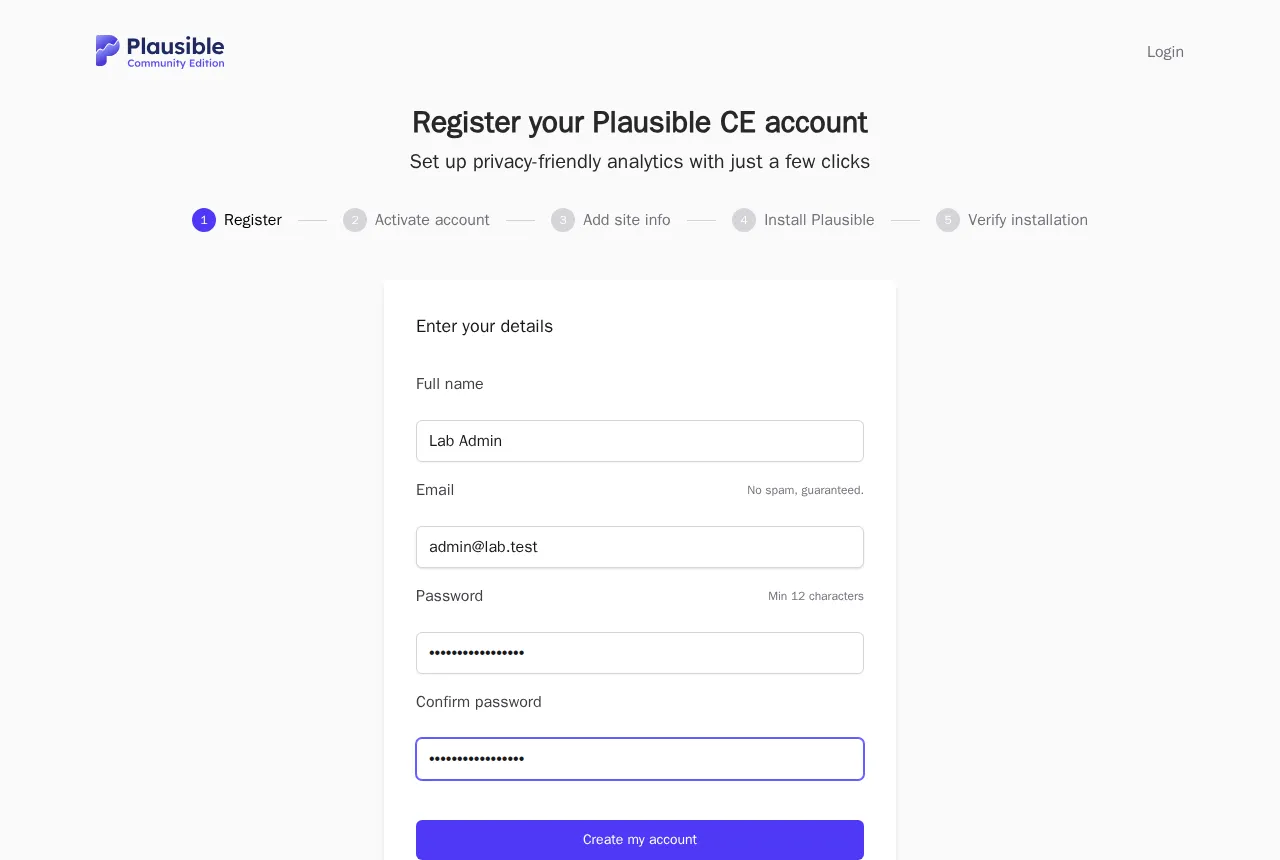
There is no email confirmation: without an SMTP configuration,
ENABLE_EMAIL_VERIFICATION is off. Verify
in PostgreSQL:
# on argo
cd ~/plausible/ce
docker compose exec -T plausible_db psql -U postgres -d plausible_db \
  -tAc "select id, email, name from users"
Expected:
1|[email protected]|Lab AdminSave your progress? Sign up for free
Drill 5: The site and the snippet
After registration, Plausible asks for the first site. Enter
itdrills.com – without https://, without
www. Plausible then shows the snippet for the website’s
<head>.
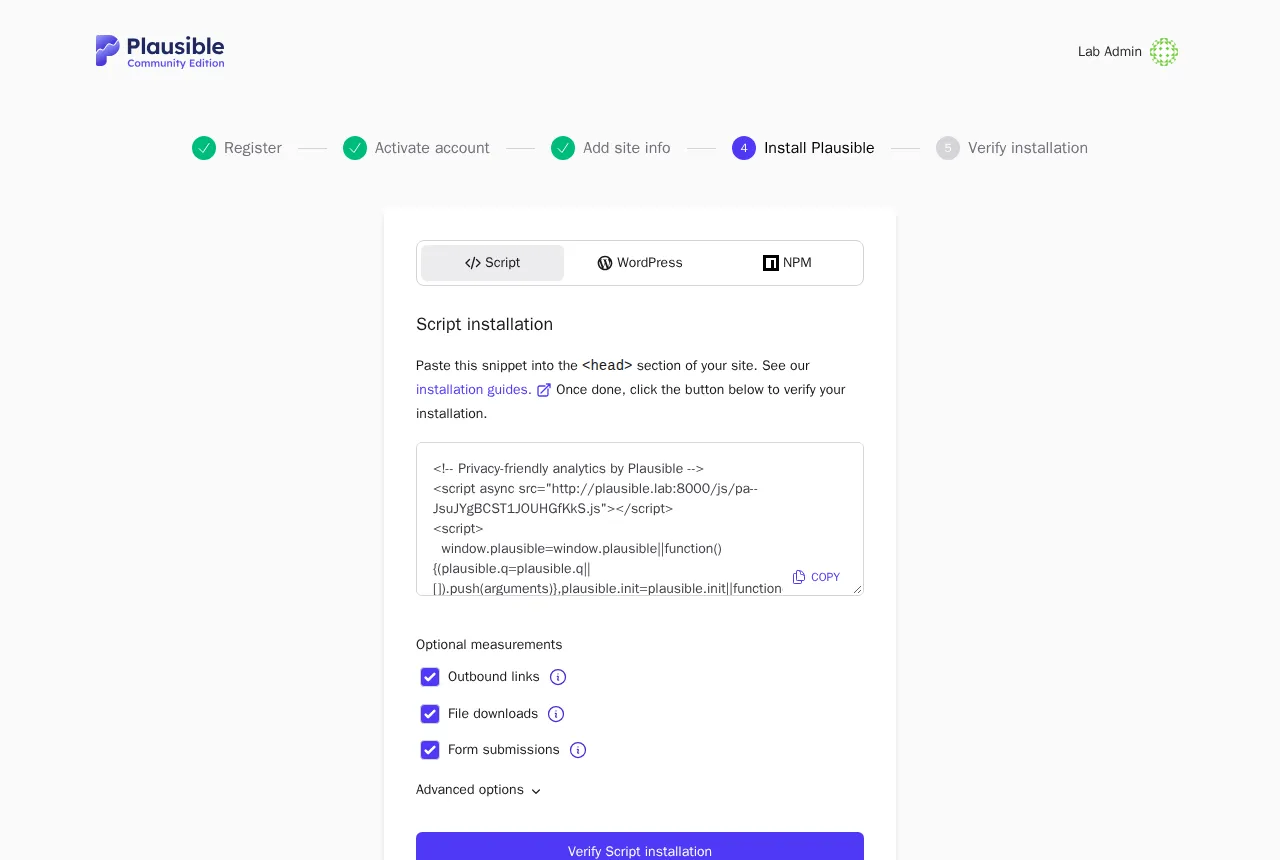
Copy the snippet into a file – you need it on Day 3:
<!-- Privacy-friendly analytics by Plausible -->
<script async src="http://plausible.lab:8000/js/pa--JsuJYgBCST1JOUHGfKkS.js"></script>
<script>
  window.plausible=window.plausible||function(){(plausible.q=plausible.q||[]).push(arg…
  plausible.init()
</script>
(abridged)
In this course’s version (v3.2.1), every site has a script of its own,
pa-<id>.js. The checkboxes under “Optional
measurements” (outbound links, downloads, forms) live in this script, no
longer in the snippet.
Verify:
# on argo
cd ~/plausible/ce
docker compose exec -T plausible_db psql -U postgres -d plausible_db \
  -tAc "select id, domain from sites"
docker compose exec -T plausible_db psql -U postgres -d plausible_db \
  -tAc "select id, outbound_links, file_downloads, form_submissions
        from tracker_script_configuration"
ID=$(docker compose exec -T plausible_db psql -U postgres -d plausible_db \
  -tAc "select id from tracker_script_configuration")
curl -s -o /dev/null -w '%{http_code} %{content_type}\n' \
  http://plausible.lab:8000/js/$ID.js
Expected:
1|itdrills.com
pa--JsuJYgBCST1JOUHGfKkS|t|t|t
200 application/javascript
Your ID is a different one – it is generated randomly when the site is created.
Save your progress? Sign up for free
Drill 6: Who may register?
DISABLE_REGISTRATION controls /register.
The default is invite_only: Plausible always admits the
first user, after that only invited ones. false opens
registration to everyone, true closes it completely.
# on argo
curl -s -o /dev/null -w '%{http_code} %{redirect_url}\n' \
  http://plausible.lab:8000/register
Expected:
302 http://plausible.lab:8000/loginBreak it: A colleague should be able to register themselves for one hour. Set the value and – as you are used to – restart.
# on argo
cd ~/plausible/ce
echo "DISABLE_REGISTRATION=false" >> .env
docker compose restart plausible 2>&1 | tail -1
until curl -sf http://plausible.lab:8000/api/health >/dev/null; do sleep 5; done
curl -s -o /dev/null -w '%{http_code}\n' http://plausible.lab:8000/register
Expected:
 Container ce-plausible-1 Started
302
Symptom: Registration stays closed.
Investigate and cause:
# on argo
cd ~/plausible/ce
docker compose exec -T plausible env | grep -c DISABLE_REGISTRATION
Expected:
0restart restarts the existing container
– with the environment it was created with. A changed .env
only takes effect when Compose recreates the container.
Fix and verify:
# on argo
cd ~/plausible/ce
docker compose up -d 2>&1 | tail -1
until curl -sf http://plausible.lab:8000/api/health >/dev/null; do sleep 5; done
curl -s -o /dev/null -w '%{http_code}\n' http://plausible.lab:8000/register
Expected:
 Container ce-plausible-1 Started
200
The hour is up: registration closes completely (true) –
you invite new colleagues via “People” (roles on Day 7), which then
needs invite_only.
# on argo
cd ~/plausible/ce
sed -i 's/^DISABLE_REGISTRATION=.*/DISABLE_REGISTRATION=true/' .env
docker compose up -d 2>&1 | tail -1
until curl -sf http://plausible.lab:8000/api/health >/dev/null; do sleep 5; done
curl -s -o /dev/null -w '%{http_code} %{redirect_url}\n' \
  http://plausible.lab:8000/register
Expected:
 Container ce-plausible-1 Started
302 http://plausible.lab:8000/login
Save your progress? Sign up for free
Exercise: Speed Drills
- Show which ports the three services listen on. Target time: 15 s
- Show the stack’s four volumes. Target time: 15 s
- Show which Plausible version runs in the container. Target time: 20 s
Solution
# on argo
cd ~/plausible/ce
docker compose ps --format '{{.Service}} {{.Ports}}'
docker volume ls --format '{{.Name}}' | grep '^ce_'
docker compose images plausible --format json | jq -r '.[0].Tag'
Expected:
plausible 0.0.0.0:8000->8000/tcp, [::]:8000->8000/tcp
plausible_db 5432/tcp
plausible_events_db 8123/tcp, 9000/tcp, 9009/tcp
ce_db-data
ce_event-data
ce_event-logs
ce_plausible-data
v3.2.1
Only plausible is reachable from outside; the databases
talk only inside the Compose network.
Save your progress? Sign up for free
Checkpoint
# on argo
cd ~/plausible/ce
curl -s http://plausible.lab:8000/api/health; echo
curl -s -o /dev/null -w '%{http_code}\n' http://plausible.lab:8000/register
docker compose exec -T plausible_db psql -U postgres -d plausible_db \
  -tAc "select count(*) from sites"
stat -c '%a' .env
Expected:
{"sessions":"ok","postgres":"ok","clickhouse":"ok","sites_cache":"ok"}
302
1
600
Challenge
A colleague wants to move the stack to port 8001 “real quick”. Change
only compose.override.yml so that Plausible is reachable
from outside on :8001 – and think about what happens to the
snippet then. Restore :8000 afterwards.
Hint: The left side of 8000:8000 is the
port on the VM.
Solution
# on argo
cd ~/plausible/ce
sed -i 's/- 8000:8000/- 8001:8000/' compose.override.yml
docker compose up -d 2>&1 | tail -1
until curl -sf http://plausible.lab:8001/api/health >/dev/null; do sleep 5; done
curl -s -o /dev/null -w '%{http_code}\n' http://plausible.lab:8001/api/health
grep BASE_URL .env
sed -i 's/- 8001:8000/- 8000:8000/' compose.override.yml
docker compose up -d 2>&1 | tail -1
until curl -sf http://plausible.lab:8000/api/health >/dev/null; do sleep 5; done
Expected:
 Container ce-plausible-1 Started
200
BASE_URL=http://plausible.lab:8000
 Container ce-plausible-1 Started
Plausible answers on :8001, but BASE_URL –
and with it every snippet on every website – still points to
:8000. Whoever changes the port has to update
BASE_URL and adjust every embedded
snippet. That is why Day 4 puts a fixed name without a port in
front.
Save your progress? Sign up for free
Cleanup
Nothing. The stack keeps running for all the following days.
Interview Note
- Which databases does Plausible need and what for? PostgreSQL for accounts, sites and settings, ClickHouse for events and sessions – column-oriented, built for aggregations over millions of rows.
- Why does a change in
.envnot take effect afterdocker compose restart? Restart keeps the container’s configuration; onlyup -drecreates it. - What does the Community Edition lack compared to the cloud? Funnels, revenue goals, SSO, the Sites API and support.
Enterprise Note
- Never edit
compose.ymlfrom the CE repo’s branch, only override it – otherwise every upgrade becomes a merge. - Generate
.envfrom a vault (sops, OpenBao) instead of by hand; the two keys are as important as the databases. - Registration on
invite_only, accounts by invitation; without SMTP there is no password reset – SMTP belongs in production (Day 9). - Plausible itself points out on every page that CE is not tested by Plausible – so test upgrades yourself.